Twisted polymer layers offer control over circularly polarized light
RIKEN researchers built an optical helix by rotating and stacking ultrathin polymer films. Layer orientation, spacing and doping tune the response from visible to near-infrared light.
·4 min read
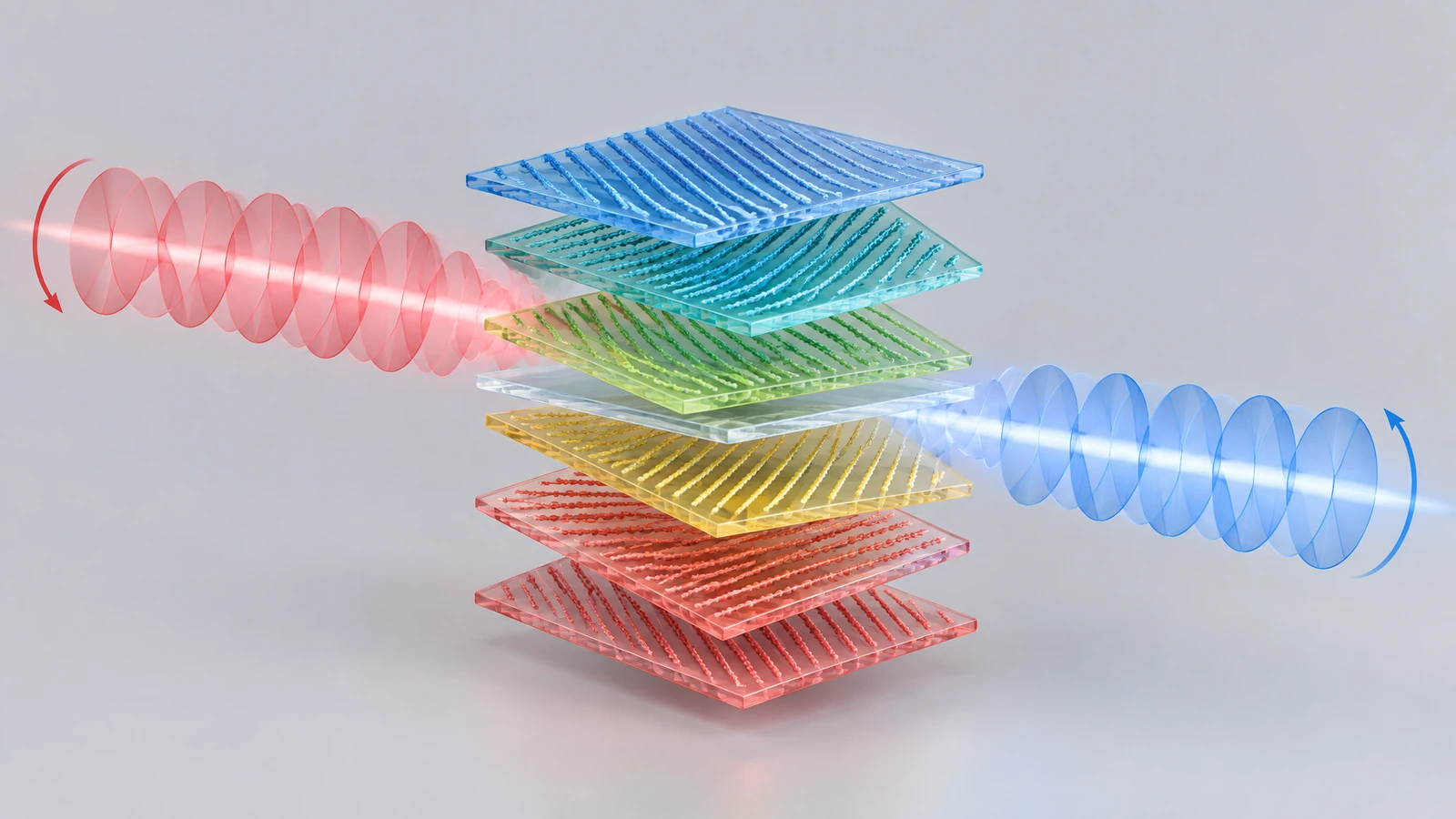
Concept illustration of rotated layer stacking and circularly polarized light, not a photograph, micrograph or measurement from the study.Illustration generated with OpenAI for Progress Radar
A polymer does not have to be intrinsically chiral to become part of a material that responds differently to left- and right-handed light. Researchers at Japan's RIKEN institute have built thin helical multilayer films by stacking aligned polymer sheets while rotating the substrate between transfers.
RIKEN announced the result on November 10, 2026. The peer-reviewed study appeared in ACS Nano on November 6. The advance is a demonstrated way to engineer optical response, not a finished optical product.
A helix assembled from flat layers
The researchers used semiconducting polythiophene, aligning the molecular chains within each individual film. They formed the films on a liquid surface and transferred them to a substrate. Rotating that substrate by a controlled angle before adding each layer produced a helix through the thickness of the stack.
The process allows the researchers to adjust the helix's handedness, the spacing between aligned layers and the number of layers. The demonstration also involved transferring layers onto a substrate measuring 25 millimeters on each side. That does not establish industrial-scale manufacturing.
Distinguishing left- and right-handed light
In circularly polarized light, the electric field rotates in one of two directions. A helical structure can absorb these forms differently. The researchers measured circular dichroism, the difference in absorption, and found that reversing the stack's handedness reversed the sign of the signal.
The experiments showed a pronounced response in the visible range. Doping the polymer to change its optical properties extended the response into the near-infrared. Transparent polystyrene spacer layers also let the team adjust the helix spacing and strengthen the response.
Predictions matched experiments
Optical simulations predicted how rotation angles and spacing would affect the material's response. For structures including five-layer stacks, the calculated spectra agreed well with the measurements. That makes the approach interesting as a design method rather than just a single material demonstration.
Possible future uses include thinner polarization-sensitive optical components and techniques for analysing chiral molecules. For now, the study establishes optical properties under controlled conditions. It does not demonstrate a finished sensor, commercial durability or superior performance across every wavelength.
Researchers stretching two slightly rotated, atom-thin graphene sheets measured an electrical response more than a hundred times as sensitive as in ordinary metals, adding a new way to probe quantum materials.
A new study uses an integrating sphere to turn irregular light patterns into exceptionally precise spectral measurements, reporting roughly 80-fold better resolution than earlier speckle spectrometers.
A new inverted architecture enables quantum-dot-electrolyte LEDs in all three primary colors, combining high efficiency with laboratory-measured stability.