New quantum-dot LEDs produce red, green and blue light with long lifetimes
A new inverted architecture enables quantum-dot-electrolyte LEDs in all three primary colors, combining high efficiency with laboratory-measured stability.
·4 min read
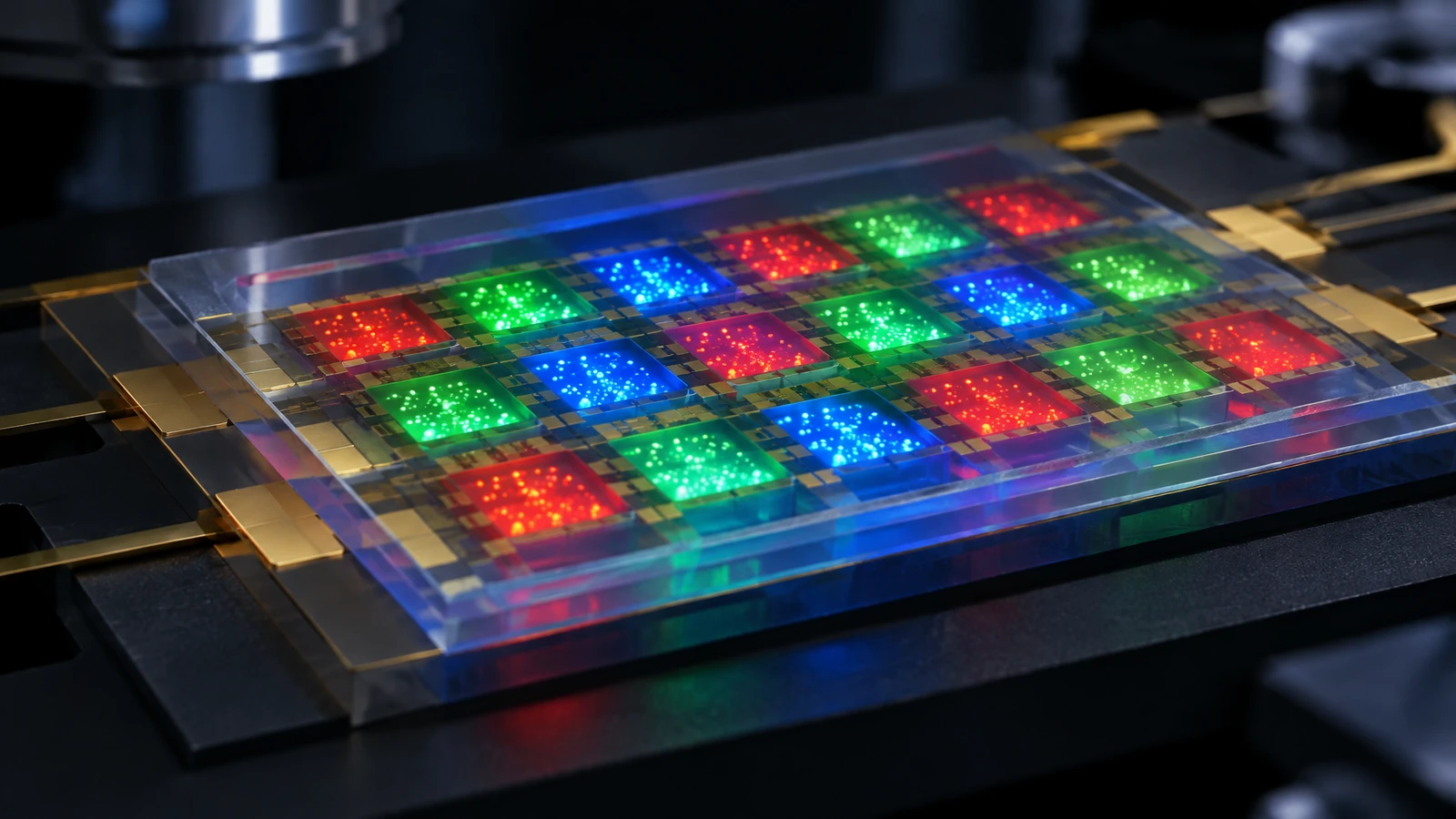
Illustration of RGB light from quantum-dot LEDs. Not an image of the researchers' experiment.Illustration generated with OpenAI for Progress Radar
Ions meet quantum dots
Quantum dots can produce highly pure and tunable light, making them attractive for displays. A newer device type, called a quantum-dot-electrolyte LED or QE-LED, mixes an ionic liquid into the quantum-dot layer. The ions can alter electric fields inside the device and make it easier to inject charges into the light-emitting layer.
Earlier work had demonstrated promising red QE-LEDs, but corresponding green and blue devices were missing. That is an important gap for any technology aimed at full-color displays, which require red, green and blue pixels.
In a new peer-reviewed Nature Communications study, researchers now demonstrate an inverted device architecture that works across all three colors.
An architecture that controls charge
In the new devices, an ionic liquid is mixed with the quantum dots to form an electrolyte-based emitting layer. According to the researchers, this improves both charge injection and transport.
They also insert an insulating layer between the emitting layer and the electron-transport layer. Its purpose is to suppress excessive electron leakage that can otherwise disrupt the balance between the charges that need to meet and generate light.
The inverted structure also addresses solvent-compatibility problems that have made it difficult to fabricate the different layers on top of one another. The result is a common basic architecture that can be used for red, green and blue QE-LEDs.
The colors still perform differently
At a luminance of 1000 candela per square meter, the red device reached a maximum external quantum efficiency of 24.2 percent. The researchers report a T95 lifetime of 13,100 hours at the same luminance. The green version reached 20.3 percent and 14,400 hours.
The blue device reached 13.5 percent external quantum efficiency and a T95 of 244.5 hours. That is far shorter than the red and green results, but the researchers describe it as record stability for solution-processed blue LEDs without light-outcoupling technologies.
T95 does not mean that the LED stops working at that point. It measures the time required for luminance to decline to 95 percent of its initial value under the stated test condition. The figures therefore should not be read as the expected lifetime of a finished consumer display.
From individual devices to active matrices
The researchers also moved beyond individual LEDs and built active-matrix displays using red, green and blue QE-LEDs. The study reports good stability and uniformity in these demonstrations, showing that the architecture can operate in more complete display structures rather than only as isolated laboratory devices.
There is still a substantial gap between a research prototype and a mass-produced display. Manufacturing yield, long-term operation across different temperatures and brightness levels, material costs and integration with industrial processes would all need to be evaluated before the technology could compete commercially.
The study primarily shows that the QE-LED concept can now cover the full RGB palette while the red and green devices combine high efficiency with long measured stability. The researchers also disclose that a patent covering the QE-LED technology described in the work was applied for in 2026.
Researchers stretching two slightly rotated, atom-thin graphene sheets measured an electrical response more than a hundred times as sensitive as in ordinary metals, adding a new way to probe quantum materials.
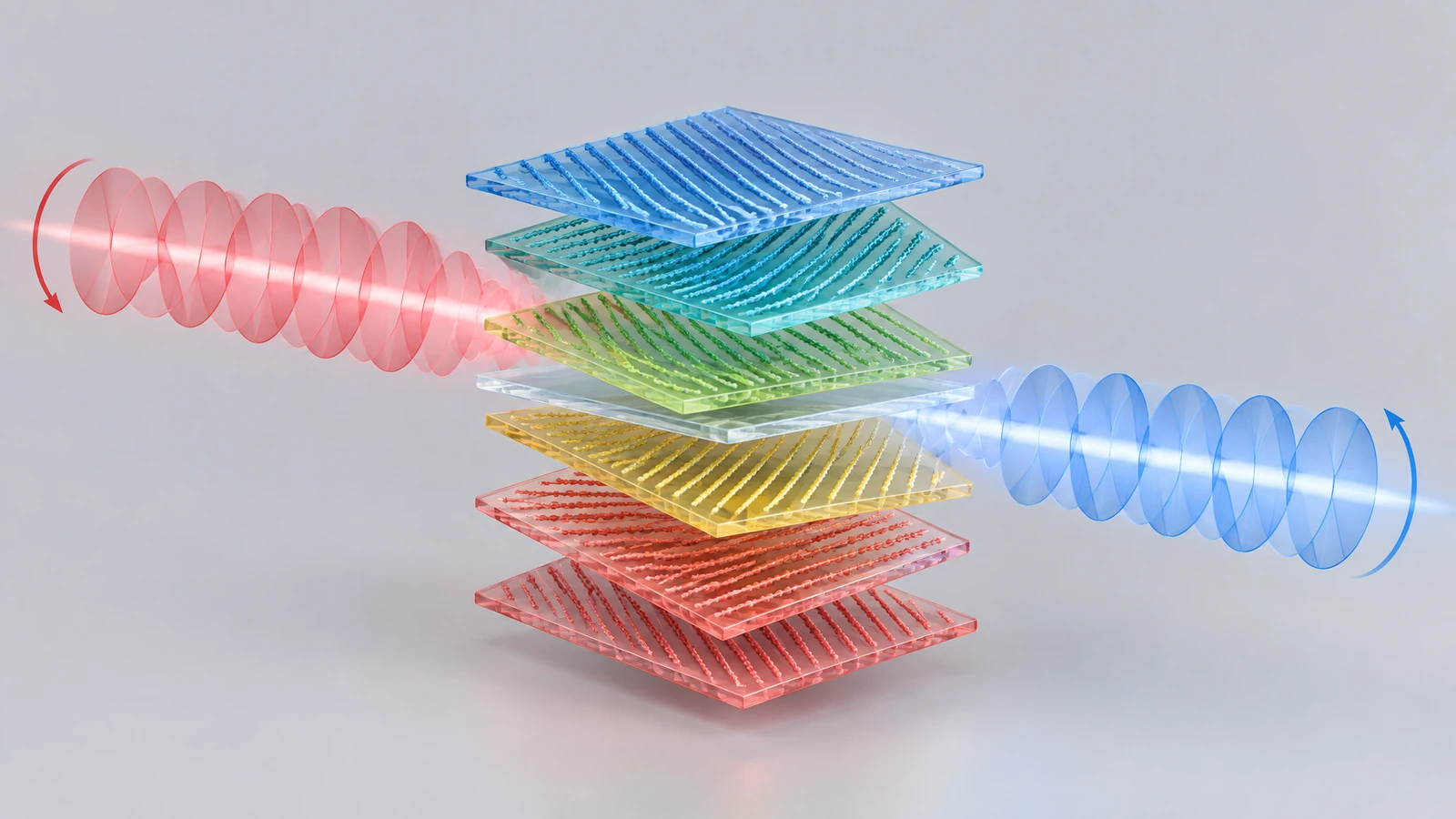
RIKEN researchers built an optical helix by rotating and stacking ultrathin polymer films. Layer orientation, spacing and doping tune the response from visible to near-infrared light.
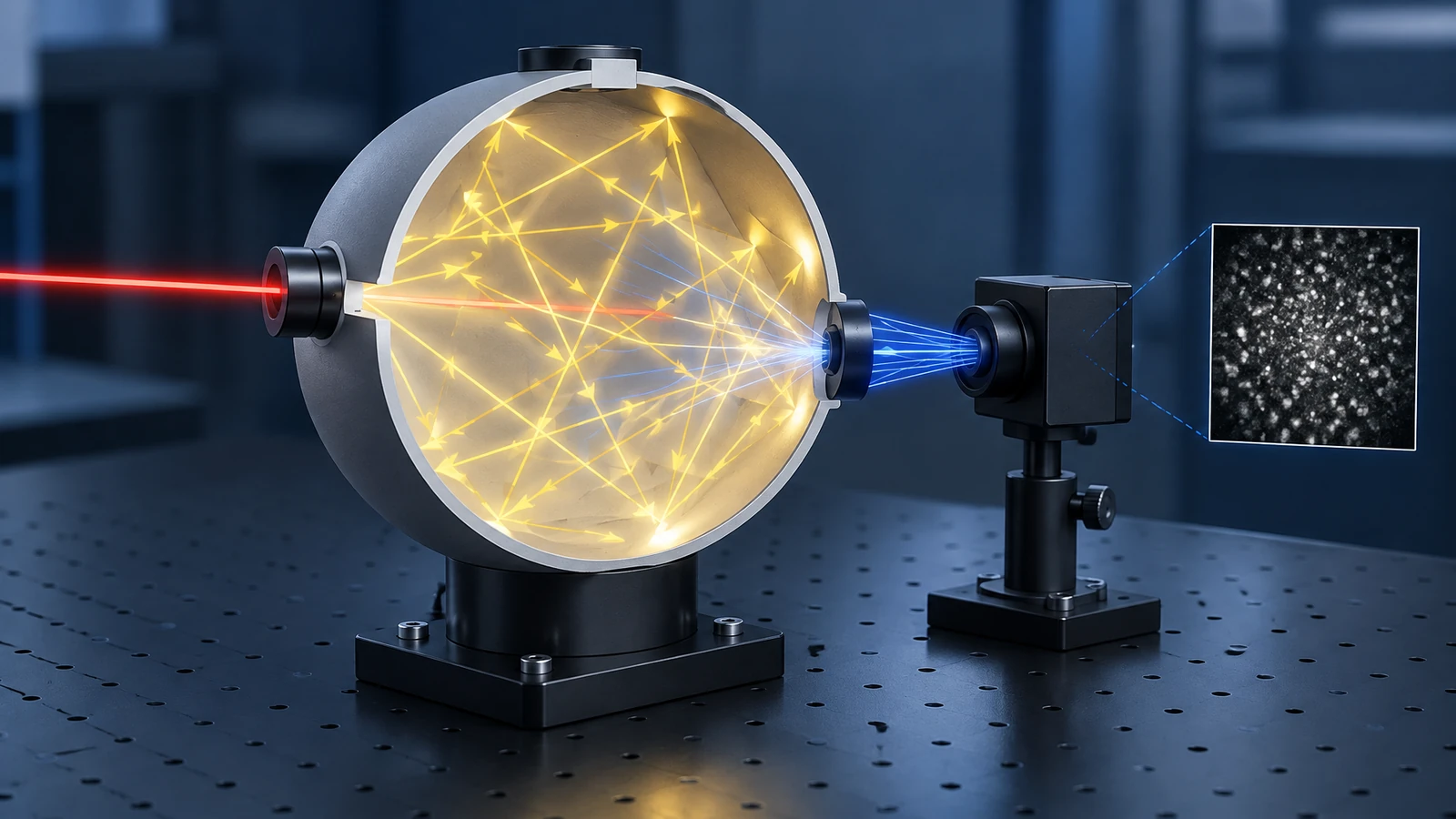
A new study uses an integrating sphere to turn irregular light patterns into exceptionally precise spectral measurements, reporting roughly 80-fold better resolution than earlier speckle spectrometers.