Phototransistor makes faint infrared light visible
A new phototransistor combines transistor and avalanche gain at low voltage and can directly drive an LED from extremely faint infrared light.
·4 min read
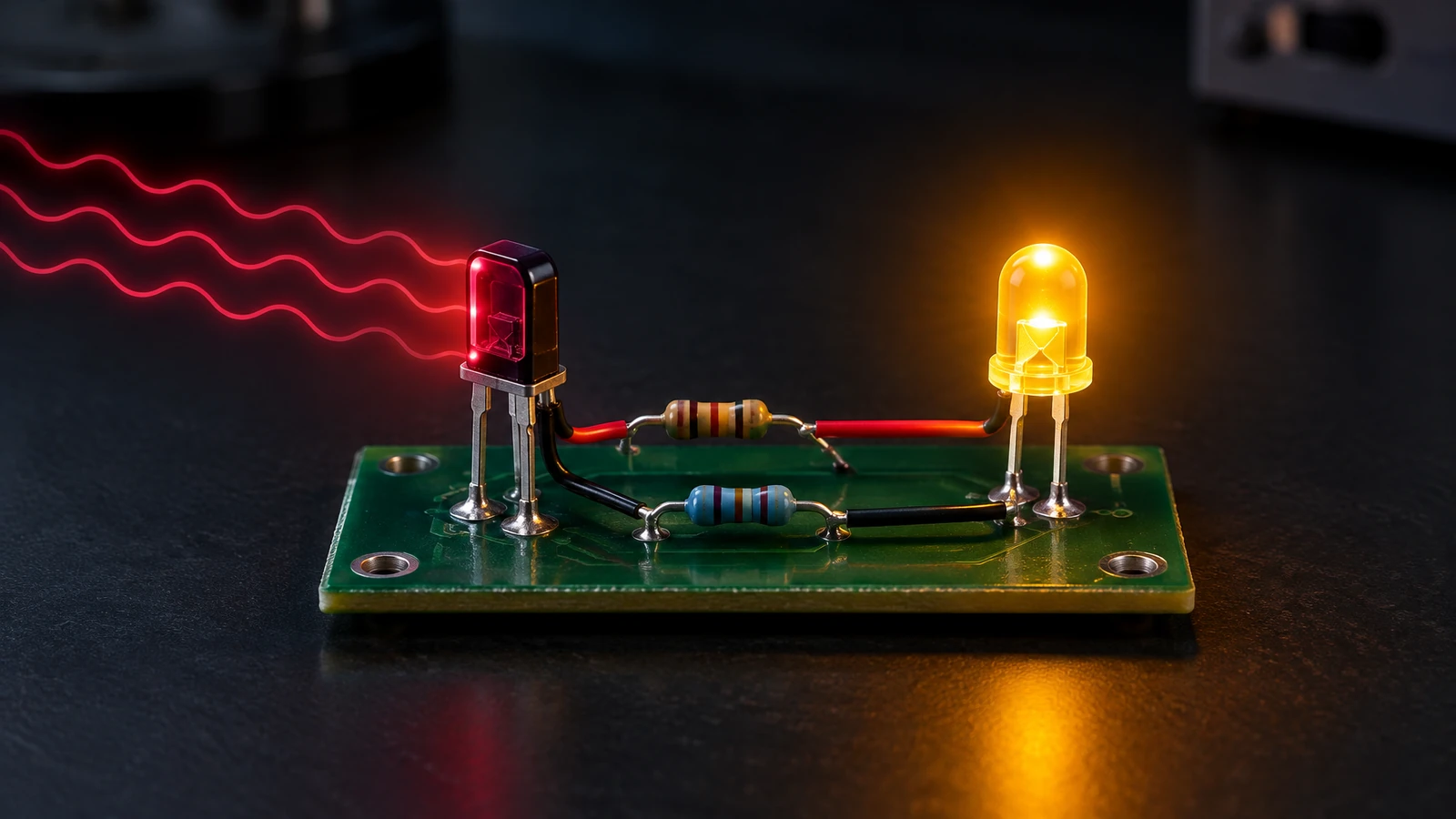
Illustration of infrared detection and electrically powered visible-light emission. Not an image from the experiment.Illustration generated with OpenAI for Progress Radar
From invisible infrared to visible light
Infrared light can be detected with sensors, but directly turning extremely weak infrared signals into visible light is difficult. Conventional optical approaches to so-called upconversion can require strong optical pumping and comparatively bulky crystals.
In a peer-reviewed Nature Photonics study, researchers demonstrate a different approach. They use an indium gallium arsenide and indium phosphide, or InGaAs/InP, phototransistor to detect infrared light, amplify the electrical signal and drive an amber light-emitting diode.
The result is a compact semiconductor-based chain in which a faint infrared signal becomes visible light without a separate optical pump providing the upconversion itself.
Two forms of gain work together
The phototransistor is engineered so that conventional transistor amplification and avalanche gain influence each other through an internal positive-feedback mechanism. In avalanche multiplication, charge carriers gain enough energy in a strong electric field to create additional carriers, sharply increasing the current.
The researchers report a breakdown voltage as low as 1.4 volts. That low voltage matters because previous semiconductor approaches have struggled to combine strong infrared sensitivity, high gain and low operating voltage at the same time.
The photocurrent from the transistor was strong enough to drive the amber LED directly in the experimental setup.
Visible light from signals near nightglow
In one demonstration, the researchers used infrared light at an intensity of only 6.4 nanowatts per square centimetre. They describe this level as close to natural nightglow.
At that input intensity, the system produced visible light that was more than 17,000 times brighter than the incident infrared light in the study's comparison.
That figure does not mean the system creates 17,000 times more energy than it receives from the light. The phototransistor and LED are electrically powered, and the result describes the brightness amplification in the demonstrated upconversion process. It is therefore not a passive conversion in which all output energy comes from the incoming infrared photons.
A possible route toward lighter night vision
The researchers point to direct-view night vision as one possible application. Rather than using a conventional system that detects infrared light, electronically processes an image and presents it on a display, a future upconverting surface could in principle make infrared light visible closer to the detector itself.
The low operating voltage and semiconductor architecture therefore make the technique interesting for compact and potentially wearable systems. The researchers also identify medical imaging and optogenetics as areas where infrared-to-visible upconversion could be useful.
But the study demonstrates a component architecture, not finished night-vision glasses. A practical imaging system would require many detector elements, optics, electrical integration and control over factors including resolution, noise, efficiency and manufacturing at larger scale.
The central result is more fundamental: the researchers show that a low-voltage phototransistor can use internal feedback between two gain mechanisms to extract a strong electrical signal from extremely faint infrared light and directly drive a visible LED. That provides a new component route for making infrared light visible without the intense optical pumping required by many conventional upconversion methods.
Researchers stretching two slightly rotated, atom-thin graphene sheets measured an electrical response more than a hundred times as sensitive as in ordinary metals, adding a new way to probe quantum materials.
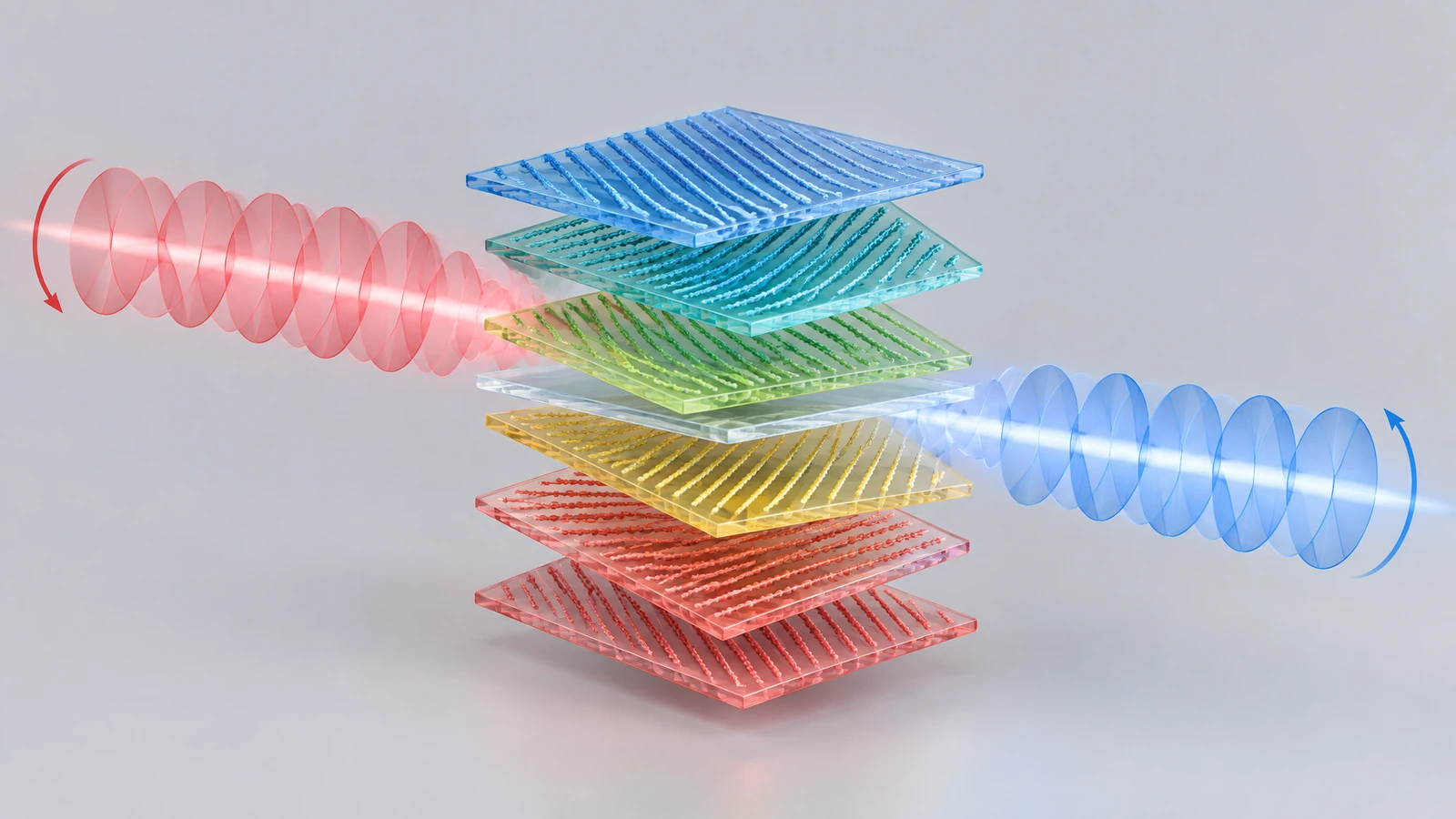
RIKEN researchers built an optical helix by rotating and stacking ultrathin polymer films. Layer orientation, spacing and doping tune the response from visible to near-infrared light.
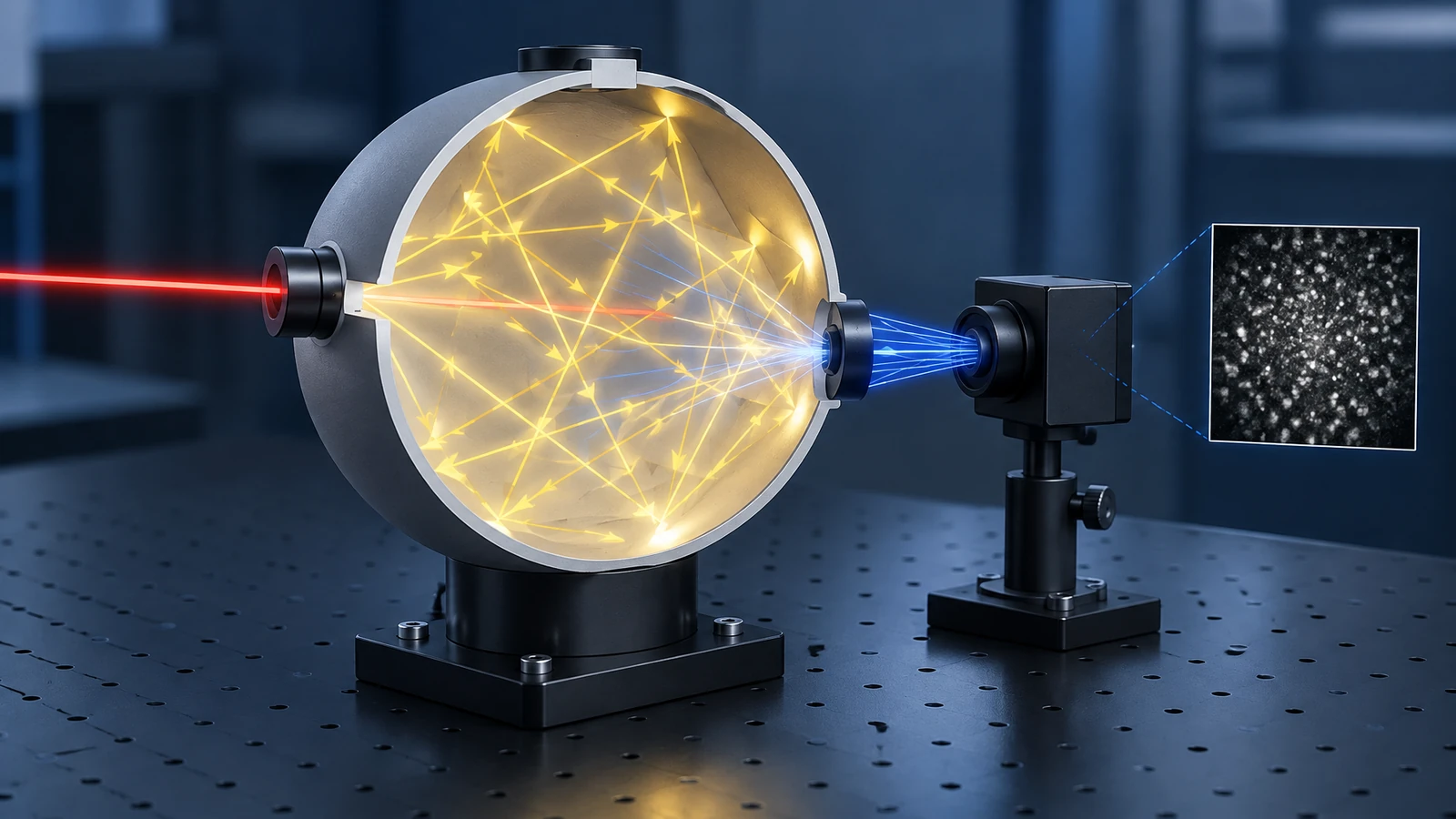
A new study uses an integrating sphere to turn irregular light patterns into exceptionally precise spectral measurements, reporting roughly 80-fold better resolution than earlier speckle spectrometers.