Quantum physics verifies location without trusting the devices
A Nature experiment demonstrates position verification using a Bell test across a quantum network. The result is promising, but its demonstrated security applies to a defined adversary model.
·4 min read
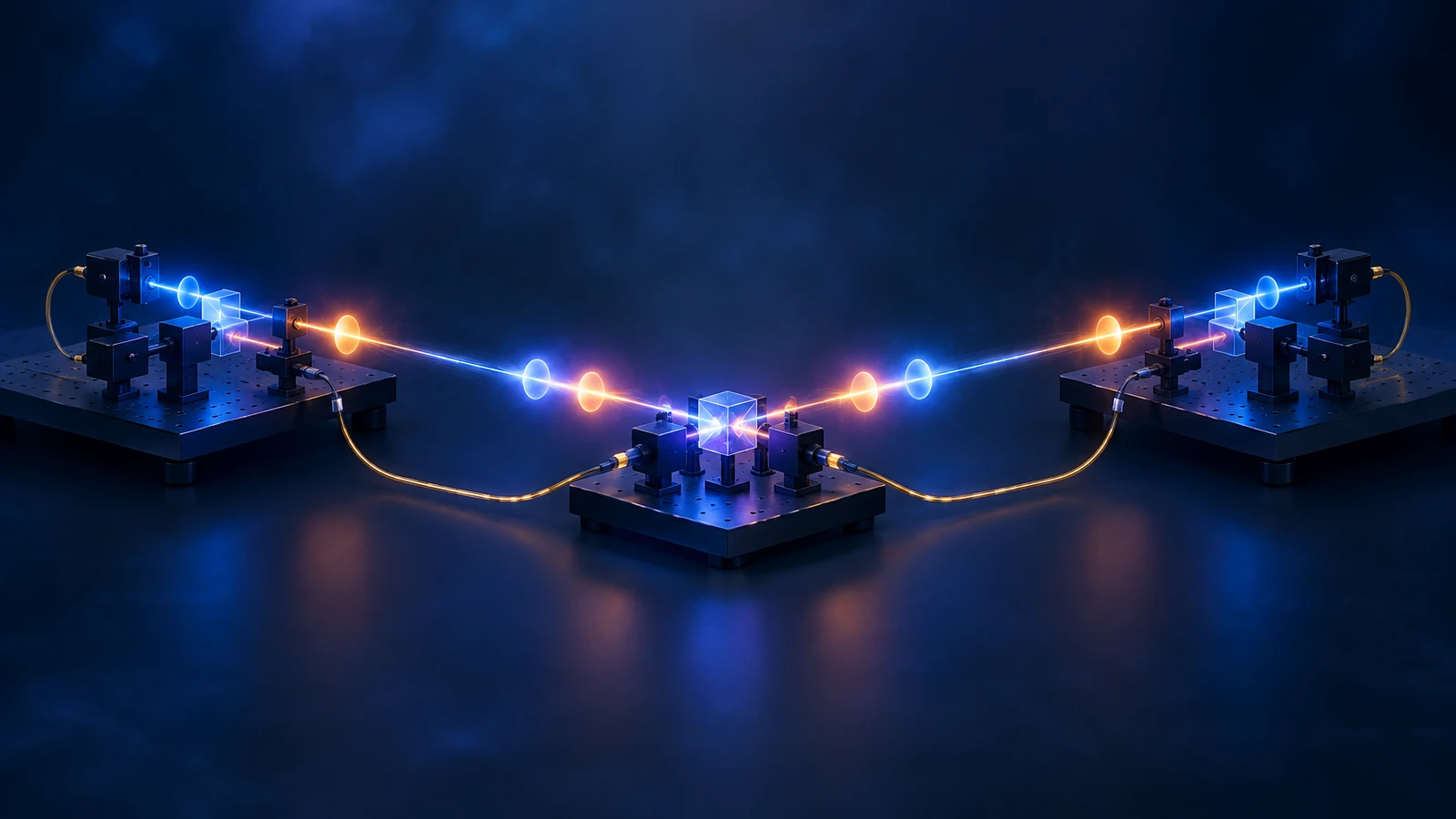
Concept illustration of quantum position verification, not a photograph of the experiment or its measurements.Illustration generated with OpenAI for Progress Radar
Why proving a location is difficult
A digital service can receive a device's reported location, but a claimed position need not be genuine. Classical signals and measurement hardware can be manipulated. Proving that a message really originates from a particular place is therefore harder than calculating a position.
In a study published in Nature on 18 November 2026, researchers present an experimental method based on quantum correlations rather than an assumption that the measuring devices are trustworthy. A preprint of the work was already available in January 2026.
A Bell test across a quantum network
The researchers demonstrated a protocol for device-independent quantum position verification. It uses observed correlations in a loophole-free Bell test. The goal is to tie a certified response to a physical location even when the devices producing that response are not assumed to be trustworthy in advance.
The experiment uses entangled photons, efficient single-photon detectors and timing-sensitive communication. Certifying the correlations matters because the security argument does not require a detailed trusted model of the measuring device's internal operation.
A smaller localization region than the classical comparison
The researchers report one-dimensional localization 2.47(2) times smaller than their best classical reference protocol. At equal latency, they report a localization volume 4.53(5) times smaller. These are specific comparisons involving localization precision and latency, not a general claim that all quantum systems outperform GPS.
The experimental security demonstration concerns adversaries who have only weak entanglement before each trial. The general protocol has broader theoretical security properties, which should not be confused with what was demonstrated in the laboratory.
A potential foundation for future authentication
A method tying digital authentication to a verifiable physical location could eventually be relevant wherever services need strong evidence of where an action occurs. The researchers mention transactions and critical infrastructure as possible applications.
The study does not demonstrate a finished product, a global positioning service or protection against every conceivable attacker. It establishes an experimental building block and a specific quantum advantage under defined conditions.
Two studies published on 16 November show autonomous error correction protecting a logical qubit beyond the best physical qubit in its system. One reports a 2.0-millisecond lifetime, 18 percent above its reference.
Researchers built a porous crystal in which light produces radical pairs with selective electron-spin polarization. Their spin response changes with the surrounding solvent, offering a possible starting point for chemically responsive quantum materials.
Researchers linked to RIKEN and Kyoto University have developed a systematic way to construct topological invariants. It fully characterizes 159 of 230 space groups in one studied class of superconductors.