Measurement-free quantum error correction crosses a key threshold
Two studies published on 16 November show autonomous error correction protecting a logical qubit beyond the best physical qubit in its system. One reports a 2.0-millisecond lifetime, 18 percent above its reference.
·4 min read
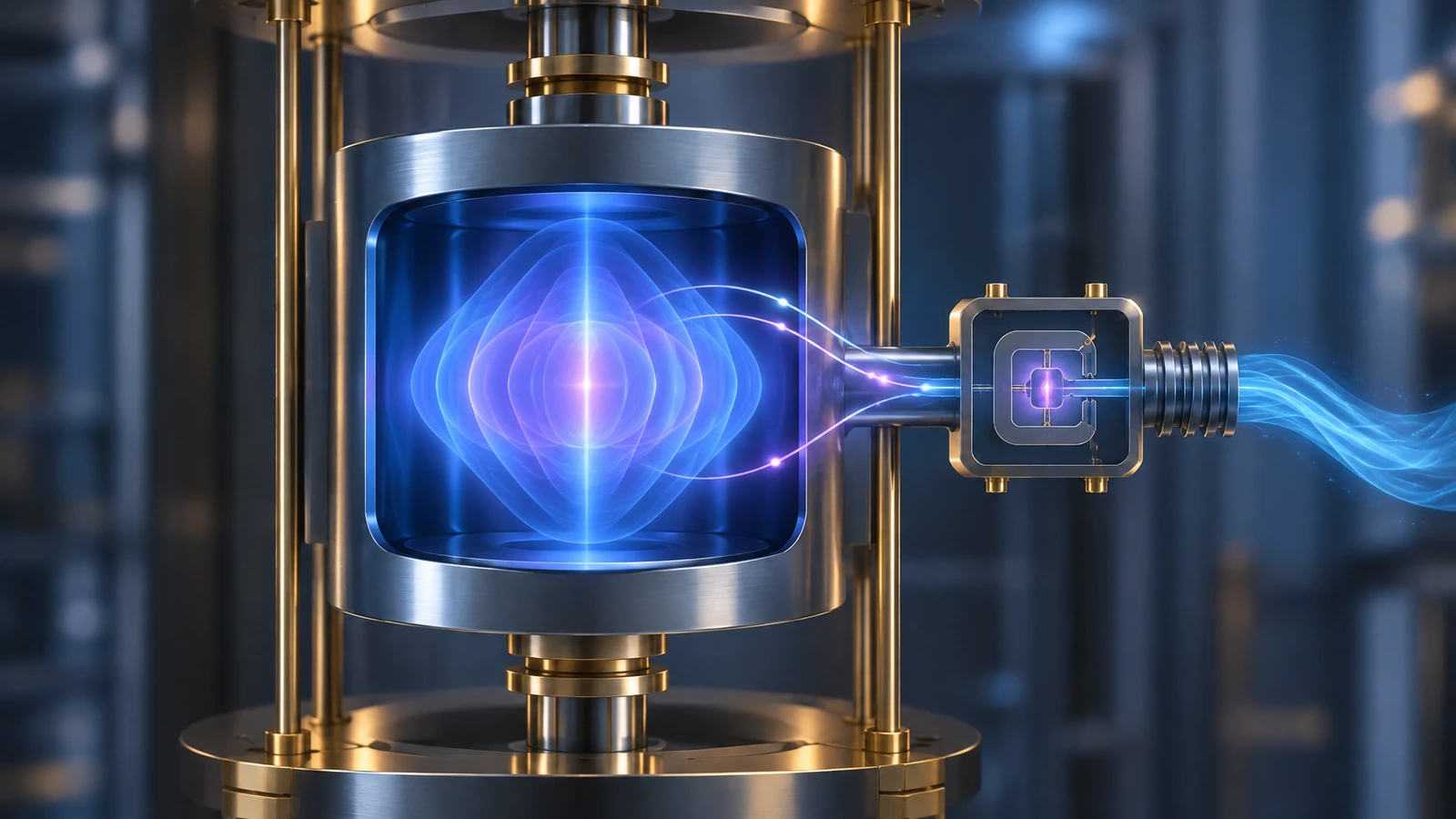
Concept illustration of autonomous quantum error correction, not a photograph of the experiment or a measurement.Illustration generated with OpenAI for Progress Radar
Quantum information needs continuous protection
A qubit gradually loses information as it interacts with its surroundings. Quantum error correction seeks to preserve information by encoding it in a larger physical state and correcting errors before they destroy a computation. Many demonstrations rely on repeated measurements, fast electronics and feedback to select corrective operations.
Two research teams reported in Nature Physics on 16 November 2026 that they had crossed an important comparison threshold using autonomous quantum error correction. Protection is engineered into the system's physical dynamics instead of relying on repeated error measurements and classical feedback. These are separate experimental demonstrations with different protocols and results.
An 18 percent lifetime improvement in one experiment
In one study, researchers encoded a logical qubit in a superconducting microwave cavity state. Using engineered dissipation to counter photon loss, they achieved a reported lifetime of about 2.0 milliseconds. That was 18 percent longer than the best physical qubit available within the same system.
The team also used its protocol to measure a small frequency shift. It reports a metrological gain of 6.3 decibels relative to the most robust Fock-state superposition in its comparison. This is a result under specific experimental conditions, not a universal improvement for quantum sensors.
A second protocol also passes break-even
In the other study, researchers used a binomial code in a long-lived bosonic mode. Their protocol transfers information about photon loss to ancillary qubits and resets them, repeatedly restoring the logical information. They report a coherence time 1.04 times that of the best physical qubit in the system.
The authors describe the method as applicable in principle to a broader class of recovery operations than earlier specialized stabilization methods. That theoretical generality is not a demonstration that all such operations work on a large processor.
A milestone, not a fault-tolerant computer
Crossing the break-even point here means that the protected logical qubit lasts longer than the selected best physical reference in the same experiment. It does not mean errors have been eliminated, that many logical qubits can reliably interact, or that these systems can already execute long, useful algorithms.
The findings demonstrate two experimental paths toward less measurement-dependent correction. Their scalability, resource costs and ability to support complete fault-tolerant operations remain open questions.
A Nature experiment demonstrates position verification using a Bell test across a quantum network. The result is promising, but its demonstrated security applies to a defined adversary model.
Researchers built a porous crystal in which light produces radical pairs with selective electron-spin polarization. Their spin response changes with the surrounding solvent, offering a possible starting point for chemically responsive quantum materials.
Researchers linked to RIKEN and Kyoto University have developed a systematic way to construct topological invariants. It fully characterizes 159 of 230 space groups in one studied class of superconductors.