Mathematical method can reveal topological properties missed by standard tests
Researchers linked to RIKEN and Kyoto University have developed a systematic way to construct topological invariants. It fully characterizes 159 of 230 space groups in one studied class of superconductors.
·4 min read
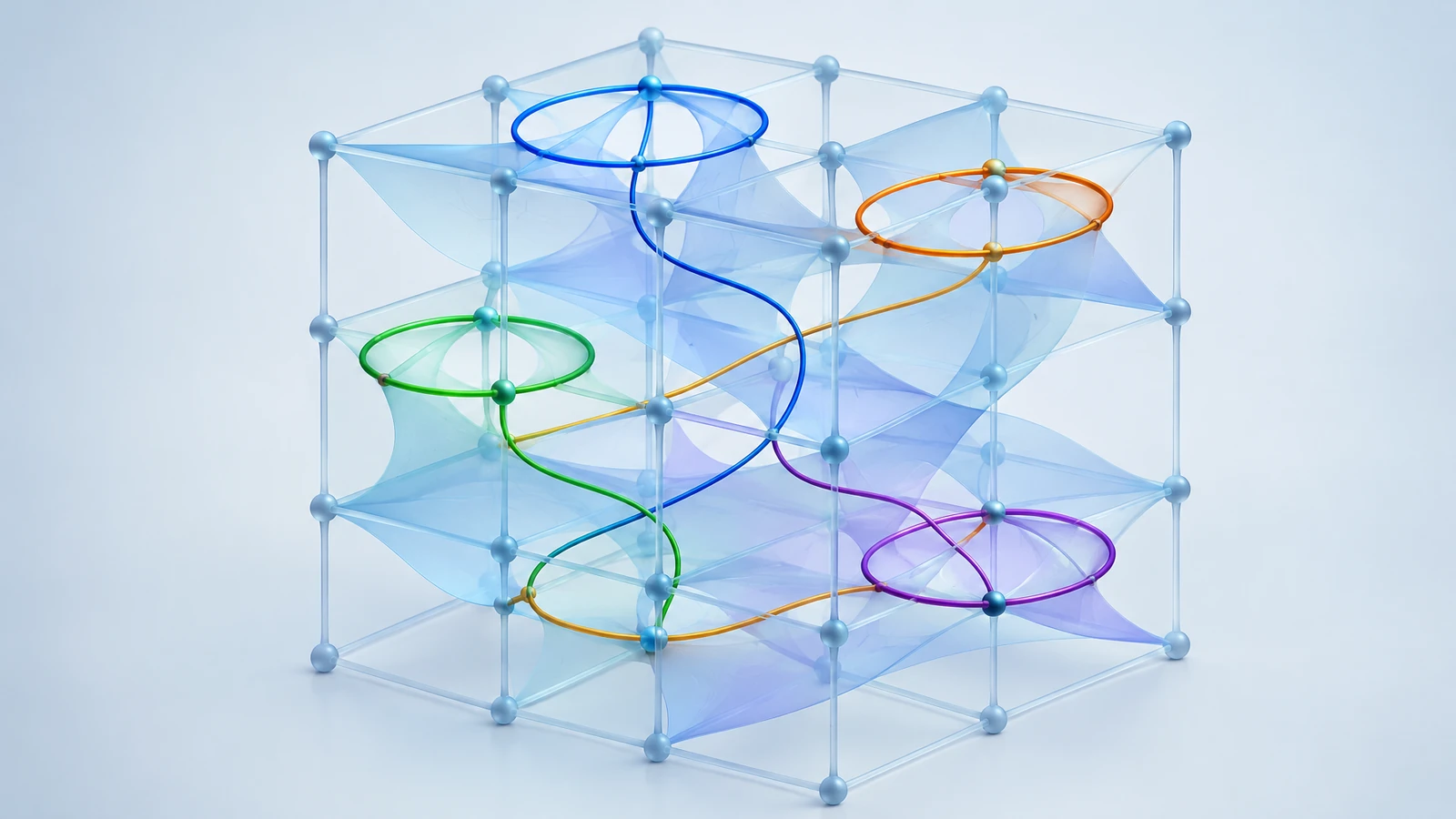
Concept illustration of topological analysis in a crystal, not a newly identified physical sample or a figure from the paper.Illustration generated with OpenAI for Progress Radar
Some electronic properties of materials cannot be identified from the most commonly used symmetry tests alone. Researchers affiliated with RIKEN, the University of Tokyo and Kyoto University have developed a mathematical method for systematically uncovering more of these topological signatures.
RIKEN highlighted the work on November 9, 2026. The peer-reviewed paper was published in Physical Review X on October 23. This is a new institutional presentation of a theoretical result, not an announcement that a new physical material has been synthesized.
Where symmetry indicators fall short
Topology concerns properties that remain unchanged under certain continuous deformations. In solids, topological signatures can be associated with the quantum states of electrons. They matter in part because they can be linked to robust states at material boundaries and may be useful for future electronics.
Standard symmetry indicators let researchers screen many materials using information at selected points in momentum space. But different topological states can produce identical results at those points. Detecting the difference requires information that the simpler indicators leave out.
From points to connecting paths
The researchers used a mathematical construction known as the Atiyah–Hirzebruch spectral sequence. It organizes information from points, lines and higher-dimensional parts of momentum space. This enables the systematic derivation of topological invariants, quantities that distinguish certain classes of quantum states.
They demonstrated the method for time-reversal-symmetric superconductors with conventional pairing symmetry, a class for which standard symmetry indicators do not provide the needed diagnosis. The resulting invariants fully characterize the relevant topology in 159 of the 230 three-dimensional space groups. RIKEN also reports complete characterization in 76 of 80 two-dimensional layer groups. The remaining groups are only partially covered.
A more detailed map for materials searches
The researchers also tested the mathematical quantities using randomly generated symmetric model Hamiltonians. Their framework shows how parts of the analysis can use information from selected points and connecting lines, potentially making broad computational screening more manageable.
Eventually, the approach could be combined with electronic-structure calculations to search for material candidates that previous screening methods overlooked. It does not demonstrate a newly discovered superconductor, a working quantum computer or lower power consumption in a practical device.
A Nature experiment demonstrates position verification using a Bell test across a quantum network. The result is promising, but its demonstrated security applies to a defined adversary model.
Two studies published on 16 November show autonomous error correction protecting a logical qubit beyond the best physical qubit in its system. One reports a 2.0-millisecond lifetime, 18 percent above its reference.
Researchers built a porous crystal in which light produces radical pairs with selective electron-spin polarization. Their spin response changes with the surrounding solvent, offering a possible starting point for chemically responsive quantum materials.