Quantum gas reaches 9.7 picokelvin aboard China's space station
An experiment aboard Tiangong measured a record-low equivalent temperature of 9.7 picokelvin and tracked the atomic cloud's free expansion for seven seconds.
·4 min read
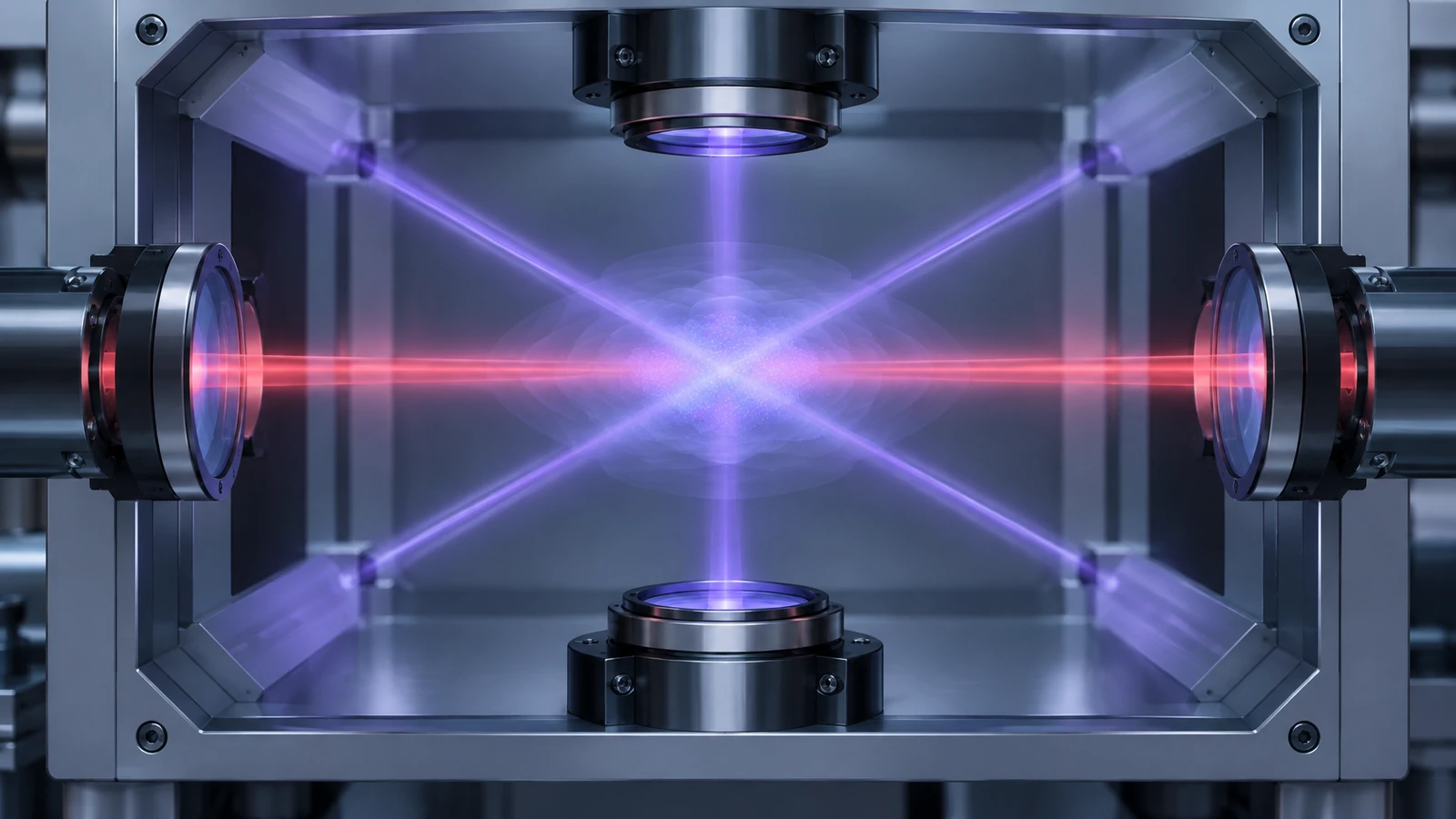
Concept illustration of an optically trapped quantum gas. Not an image or measurement from the Tiangong experiment.Illustration generated with OpenAI for Progress Radar
A cloud of rubidium atoms aboard China's Tiangong space station has reached a reported equivalent temperature of 9.7 picokelvin. That is 9.7 trillionths of a kelvin above absolute zero, inferred from how slowly the atomic cloud expands.
The result appeared in Science on November 5 and was announced by Peking University on November 6. The researchers report a new record for this type of ultracold atomic gas, but the number does not describe the temperature of the entire space station or the apparatus surrounding the atoms.
Around 20,000 atoms in a shared quantum state
The team created a Bose–Einstein condensate containing roughly 20,000 rubidium atoms. In such a condensate, many atoms can be described by a shared quantum state, making the gas useful for investigating quantum phenomena.
The atoms were trapped and cooled using laser light and evaporative cooling. They were then transferred into a wider optical trap with weaker confinement. By measuring how the cloud expanded after release, the researchers could infer its extremely low motional energy.
The reported value is 9.7 picokelvin, with an uncertainty interval from 7.0 to 12.9 picokelvin. This is an equivalent temperature derived from expansion, not an ordinary direct measurement of thermodynamic temperature.
Seven seconds to observe the cloud
The researchers tracked the cloud's free expansion for seven seconds. For comparison, they cite an earlier record of 38 picokelvin with two seconds of expansion in an Earth-based drop tower. A previous experiment on the International Space Station reported about 52 picokelvin.
In microgravity, the atomic cloud does not sag in its trap as it would in a laboratory on Earth. That makes weak optical trapping and longer observation of slow expansion more practical.
The experiment also demonstrates that an optical dipole trap can produce a Bose–Einstein condensate in microgravity. Such traps can offer more flexible control of atoms than some magnetic approaches.
A platform for future measurements, not a finished instrument
Extremely cold, slowly moving atoms can give scientists more time to investigate quantum systems. The method could eventually support quantum simulation and atom interferometers, which exploit the wave properties of atoms for precision measurements.
For now, however, the study primarily demonstrates a new temperature and observation limit in a particular experiment. It does not establish improved gravity measurements or a finished quantum sensing instrument. Those applications will need separate experiments.
A Nature experiment demonstrates position verification using a Bell test across a quantum network. The result is promising, but its demonstrated security applies to a defined adversary model.
Two studies published on 16 November show autonomous error correction protecting a logical qubit beyond the best physical qubit in its system. One reports a 2.0-millisecond lifetime, 18 percent above its reference.
Researchers built a porous crystal in which light produces radical pairs with selective electron-spin polarization. Their spin response changes with the surrounding solvent, offering a possible starting point for chemically responsive quantum materials.