Can robots learn the job in a virtual world?
Humanoid robots need enormous amounts of experience before they can work reliably in the real world. DexForce wants to move much more of that training into simulation.
Search will be available as the English edition grows.
Researchers have developed an artificial skin with more than 10,000 touch sensors that organizes signals more like the human nervous system. In experiments, it let robots detect very fine surface structures and react automatically to potentially harmful contact.
A humanoid robot can have advanced cameras, powerful language models and precise motors. But if it is to grasp fragile objects, handle tools or work closely with people, it also needs something we usually take for granted: a body that can feel when it is touched.
That becomes difficult when thousands of sensors must cover large parts of the robot.
A research team led from the Southern University of Science and Technology has now demonstrated an artificial skin designed to address this scaling problem. The system is called neural-hierarchical iontronic skin, or NI-skin, and is described in a peer-reviewed study published in Nature Machine Intelligence on October 16.
Electronic skin for robots is not new. The challenge emerges when the number of sensors becomes large.
Many existing sensor systems read signals sequentially. As more sensors are connected, this can increase latency, interference between signals and demands on data capacity.
The researchers point to human skin as an alternative architecture. It does not send raw information from every receptor directly to the brain as one enormous data stream. The sensory system organizes and processes information hierarchically along the way.
NI-skin attempts to do something similar electronically.
The demonstrated system contains more than 10,000 sensor units, with a density of up to 1,110 sensors per square centimetre.
The sensors are iontronic. They use electrical properties that arise as ions move through soft materials, enabling sensitive detection of pressure and contact.
The distinctive feature, however, lies just as much in how the signals are organized.
The researchers use frequency-based positional encoding so information from many sensors can be transmitted in parallel. The signals are then aggregated and compressed before being passed to higher processing levels in the robot.
According to the study, this convergent processing reduced data requirements by hundreds of times while allowing the sensor system to deliver information at up to 100 frames per second.
The researchers mounted the skin on robotic systems to test whether the architecture could do more than simply produce measurements.
In experiments, the robots detected surface details down to 300 micrometres, equivalent to 0.3 millimetres.
Other demonstrations included a robotic gripper handling 0.5-millimetre mechanical-pencil lead and 0.2-millimetre soft solder wire.
This illustrates why touch may become important for humanoid robots. Vision alone does not necessarily reveal how tightly an object is being held, whether it is beginning to slip or whether a fragile item is about to be crushed.
The researchers also demonstrated a simpler parallel to the human pain response.
NI-skin could detect mechanical stimuli classified as harmful and trigger an automatic protective reaction. In one demonstration, the robotic system responded to contact with a spiky chestnut shell.
That does not mean the robot experiences pain.
Here, ‘nociceptive’ signals are used in the technical sense: the system detects stimuli that could damage the robot and links them to a protective action. The notable point is that the response can be built into the body's sensory system instead of requiring all information to be processed centrally first.
Humanoid robots are increasingly being developed as general-purpose machines that can move through and manipulate objects in environments designed for people.
That creates a somewhat paradoxical problem.
The more of the body that is equipped with sensors, the more information must be processed. A robot with highly sensitive skin can therefore develop a data problem precisely because its skin has become better.
NI-skin addresses this by taking inspiration not only from human sensors, but also from the way the nervous system organizes information.
That distinguishes the work from simply building an even more sensitive pressure sensor.
The study does not demonstrate a finished artificial skin that can simply be wrapped around a commercial humanoid robot.
Long-term durability, large-scale manufacturing, integration across complex three-dimensional robot bodies and robust operation outside the laboratory are among the problems that still need to be solved. Earlier research on iontronic skin also identifies environmental stability and scalable manufacturing as central challenges for the field.
The researchers therefore describe the result as a route toward more human-like touch and manipulation, not as a recreation of human skin.
But the demonstration shows something important for the next generation of robots: if humanoids are to have thousands or millions of body sensors, making the sensors smaller and better will not be enough.
The nervous system around them will also have to become smarter.
KEEP EXPLORING
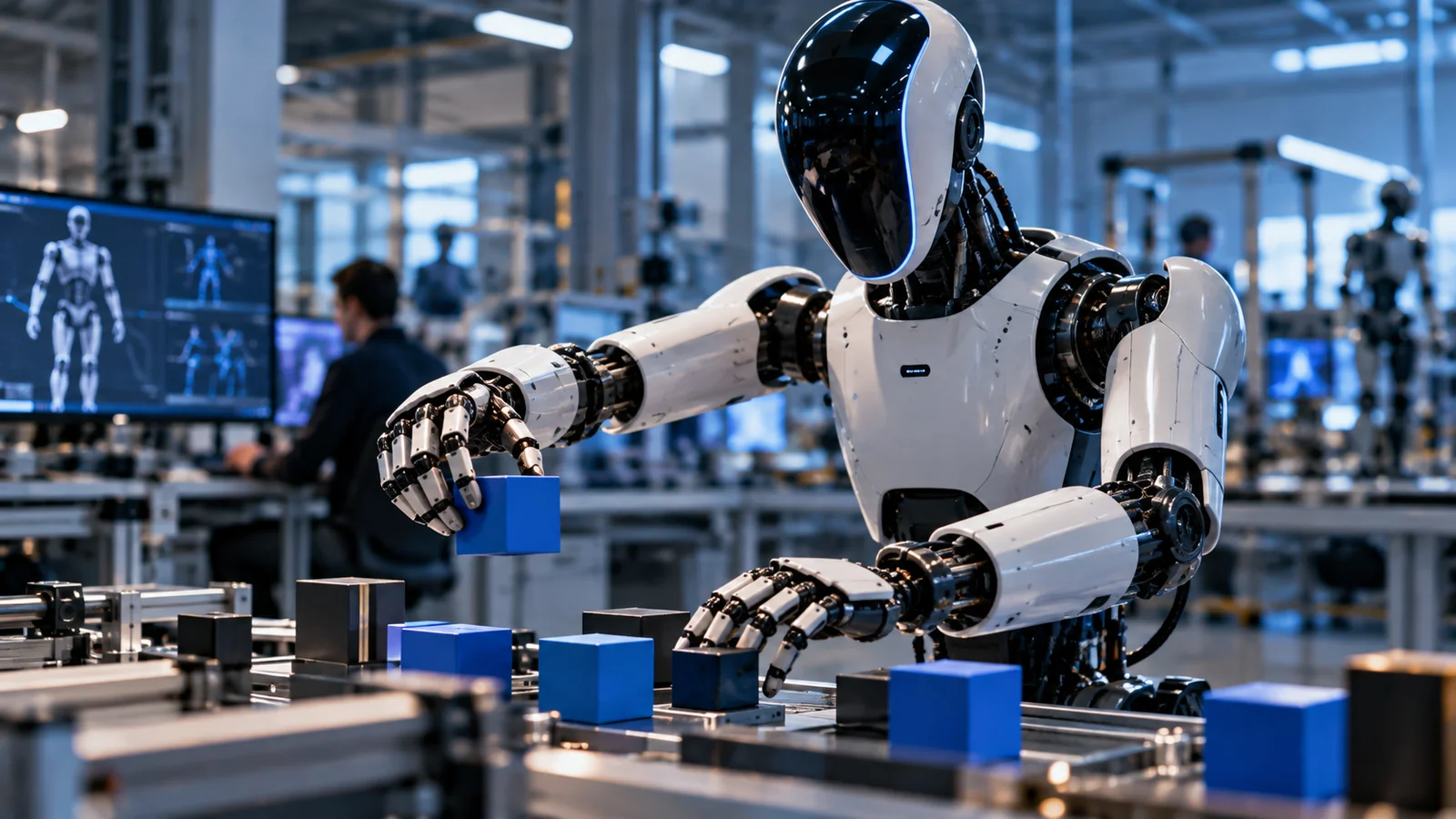
Humanoid robots need enormous amounts of experience before they can work reliably in the real world. DexForce wants to move much more of that training into simulation.
Measurements in an electron-doped copper oxide directly link superconductivity to antiferromagnetic spin fluctuations. The result resolves an important part of the puzzle, but not the mechanism behind the highest transition temperatures.
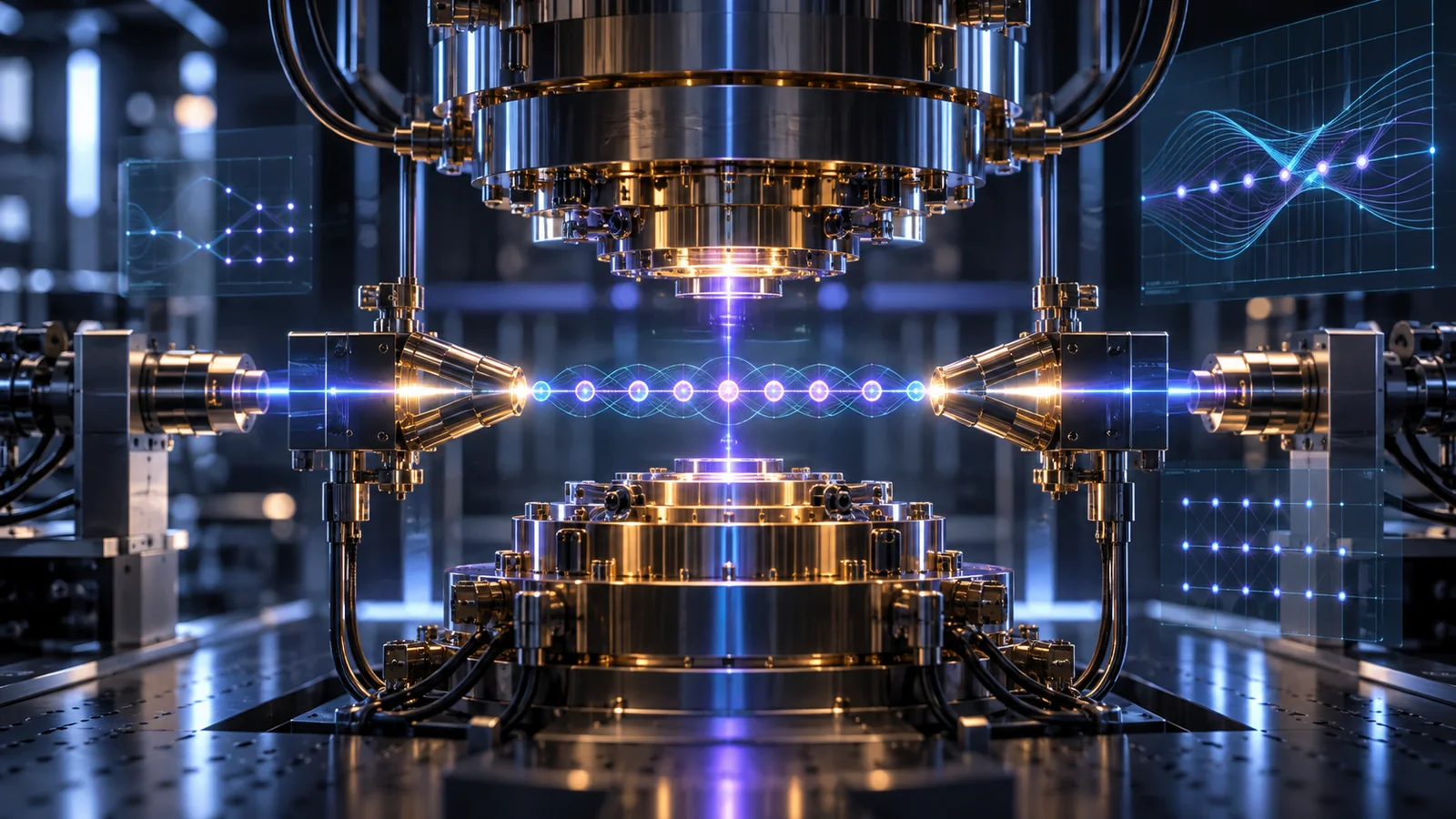
Quantinuum reports 99.9995% logical memory fidelity on its Helios system. The result shows strong error suppression with a color code, while scaling to useful fault-tolerant computation remains unproven.