Humanoid robots need enormous amounts of experience before they can work reliably in the real world. DexForce wants to move much more of that training into simulation.
·7 min read
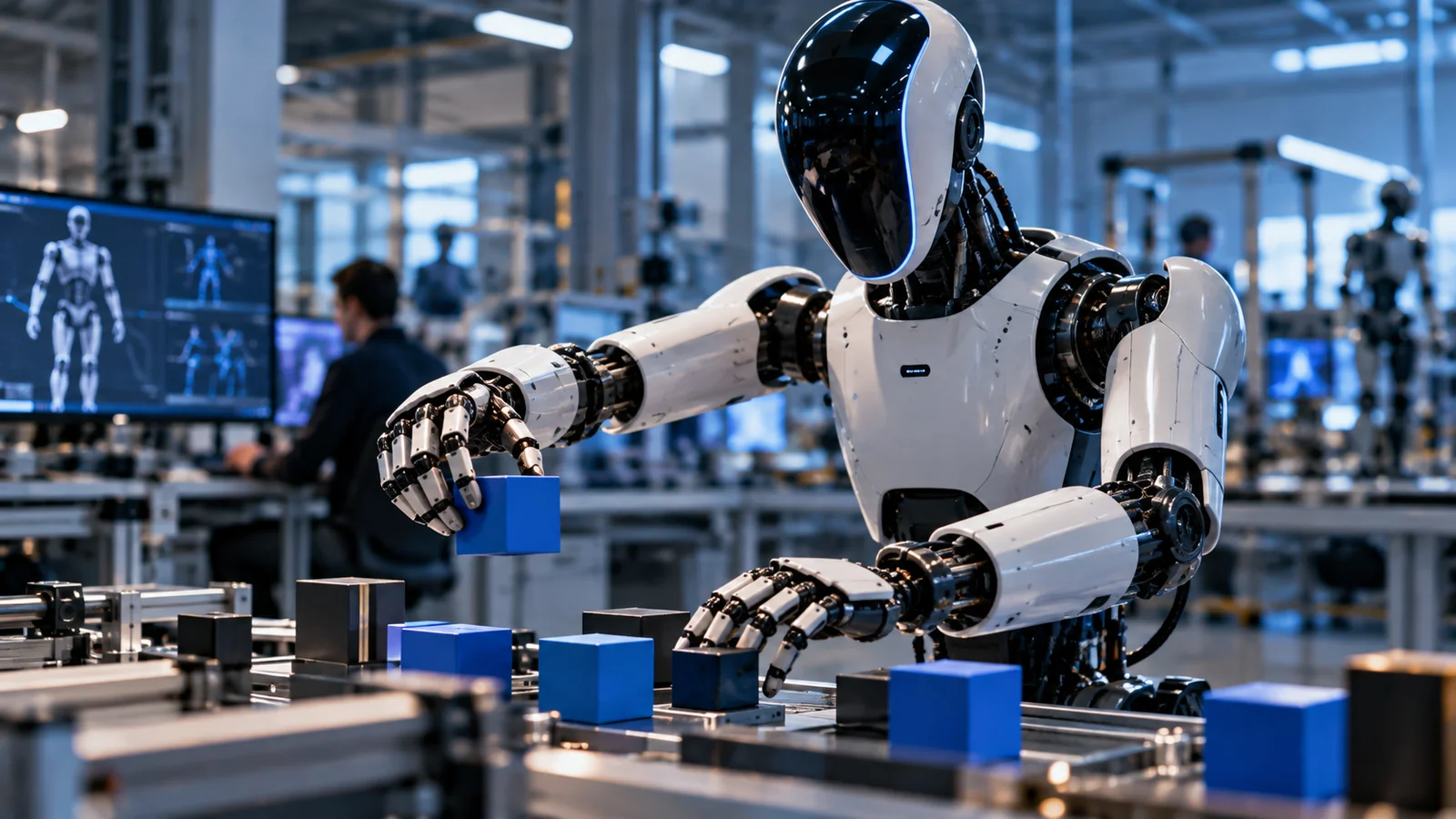
Concept illustration of robot training and transfer from simulation to physical manipulation, not an actual image from DexForce.Illustration: Progress Radar
Robots need more than capable hands
A humanoid robot can look impressive while walking, lifting a box or serving a cup of coffee. The harder part begins when the task no longer takes place under the same conditions the robot practised in.
A cup is a few centimetres farther to the left. A person suddenly walks past. The light changes. An object has a different shape or weight than expected. For people, such variation is a normal part of everyday life. For a robot, it can be the difference between succeeding and stopping completely.
That is one reason training data has become an increasingly important bottleneck in robotics. A robot must learn not only what one task looks like, but enough variations to handle the same task under many different conditions.
DexForce, a robotics company from Shenzhen, is trying to address parts of this problem by moving much more training into simulation. Reuters reports that the company builds virtual versions of workplaces and tasks, trains robot models there and then tries to transfer what they have learned to physical machines.
The idea is straightforward: if a robot can perform huge numbers of training attempts digitally, each attempt does not require a physical robot, a real workplace and a person demonstrating the task.
A factory that exists only inside a computer
DexForce describes part of its technology as Real2Sim2Real. Information from the real world is used to build or adapt a simulated environment. The robot can then train digitally before the learned behaviour is transferred to physical hardware.
The company's DexVerse and EmbodiChain systems are designed to produce large amounts of synthetic training data. On its English website, DexForce describes its Real2Sim2Real-VLA as a model based primarily on synthetic data.
The difference from traditional data collection could be substantial. Reuters quotes DexForce founder Kui Jia saying that precise human demonstrations can in some cases require more than a hundred repetitions of the same movement. The problem grows quickly if a more general robot must learn many tasks with even more variations.
In simulation, much of this variation can be generated automatically. Lighting can change, objects can move and physical parameters can vary. Robot actions can be repeated at scale without physical equipment having to be reset between attempts.
On paper, that is a powerful shortcut. The question is how much of the learning survives contact with reality.
Research shows the idea is more than theory
The DexForce team published UNITAS in October, a research model that represents robot movements and changes in the environment in a shared three-dimensional space.
The researchers report 99.8 percent success on the LIBERO benchmark and an average of 85 percent on the physical tasks they tested. The results are interesting, but UNITAS is currently a preprint from the DexForce team itself. The figures should therefore be read as the researchers' reported results, not independent confirmation that general robot learning has been solved.
At the same time, independent research supports the underlying sim-to-real principle. At CVPR 2026, researchers presented a humanoid policy trained entirely on synthetic simulation data that could transfer directly to physical tasks involving several types of doors.
Another CVPR study used more than 630,000 synthetic robot trajectories across multiple robot types, skills and tasks. The researchers reported that the model could match a strong model trained on large amounts of real robot data in their evaluations.
That does not make real training data obsolete. But synthetic data has evolved from a practical supplement into an increasingly serious candidate for large-scale robot training.
Then the robot leaves the simulator
The problem is that the real world is never a perfect simulation.
A virtual table has exactly the properties assigned to it by the simulator. A real table may be slightly uneven, more slippery than expected or vibrate when something hits it. Cameras have noise. Motors do not respond identically every time. Friction, materials and lighting vary, and people move in ways developers did not plan for.
This is often called the sim-to-real gap: the distance between what a robot learns in a simulated world and what actually works when the same strategy is used on a physical machine.
Roland Berger identifies synthetic data and physics-based simulation as important ways to generate training data, particularly for rare situations and edge cases. At the same time, its analysis describes large and varied datasets as a continuing bottleneck for humanoid robotics.
Modern training methods therefore deliberately make simulators less predictable. Lighting, camera conditions, objects and physical parameters can be varied so the robot does not learn one perfect virtual world, but many different versions of it.
The goal therefore does not have to be replacing real data completely. The larger gain may come if simulation lets much more basic training happen before expensive and slow physical training begins.
A market still in its early stages
It is easy to get the impression that humanoid robots are already entering factories in enormous numbers. The figures tell a more cautious story.
The International Federation of Robotics estimates that about 7,000 humanoid robots were sold globally in 2025 for industrial and professional service applications. Many were bought by research organizations or companies using them to develop AI rather than for routine productive work.
By comparison, about 542,000 traditional industrial robots were installed in 2024. Humanoids therefore remain a very small part of the global robotics market.
That makes the training problem even more important. If humanoid robots are to move from pilots and demonstrations to useful machines at scale, teaching each new task must become cheaper and faster.
Reuters reports that DexForce technology is used by manufacturers including Toyota, Samsung and Foxconn, and that the company's humanoid robots are used in service tasks in more than 15 Chinese cities. This shows the technology has moved beyond the laboratory, but says little yet about how general the robots really are or how much adaptation each new environment requires.
What matters is what happens with the next task
The most important test for this kind of technology therefore does not come when a robot completes a task it has trained on for a long time. It comes when the robot encounters the next one.
Can a model that learned to handle one kind of box understand another? Can it apply what it learned in one warehouse to a new building? Can knowledge from one robot model transfer to another without restarting the entire training process?
If the answer gradually becomes yes, synthetic data could change the economics of the entire robotics industry.
The simulator would then become more than a place where engineers test their robots. It would become the school robots attend before they meet the world.
Researchers have developed an artificial skin with more than 10,000 touch sensors that organizes signals more like the human nervous system. In experiments, it let robots detect very fine surface structures and react automatically to potentially harmful contact.
Measurements in an electron-doped copper oxide directly link superconductivity to antiferromagnetic spin fluctuations. The result resolves an important part of the puzzle, but not the mechanism behind the highest transition temperatures.
Quantinuum reports 99.9995% logical memory fidelity on its Helios system. The result shows strong error suppression with a color code, while scaling to useful fault-tolerant computation remains unproven.